Today's
EarthStation1.com 15% Off Commemorative Memorial Title: The
Kellogg Brothers Corn Flake Kings Biography MP4 Video Download DVD
Today, February 27, 2026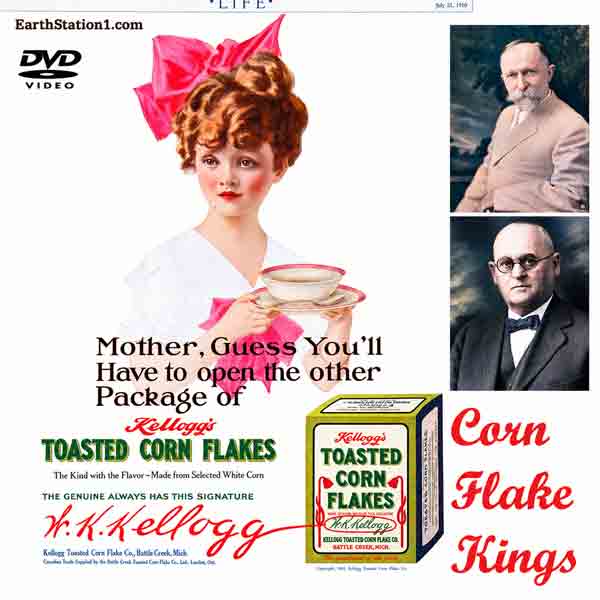
February 27: Big Breakfast Day: -- We
love breakfast as much as the next person, but there's something
unique about this day - it's a day for a BIG breakfast! It honors
a meal many consider the most important of the day. We think
that's pretty huge because it celebrates breakfast foods and
snacks and encourages people to eat breakfast, something that many
Americans and people from other nationalities skip for dietary
reasons. We want to encourage everyone to start eating their
breakfast again, and what better way to do that than by
celebrating The Big Breakfast Day? What's the first thing we do
after waking up and checking our phones? We think about what we
want for breakfast - and the options are endless! Sure, you have
your classics, like cereal, toast, eggs, and bacon, but in true
foodie spirit, you can give anything a breakfast twist. You can
even have breakfast for dinner, or as the British call it,
'brinner.' It comes so naturally to us that we don't even have to
think about it. Most people can walk to the kitchen with their
eyes closed to grab a bowl of cereal or dish up some yogurt and
fruit. Many of us have been conditioned to believe that breakfast
is the most important meal of the day, and nothing could be more
accurate. It's one of the most significant decisions you make
because what you eat determines how energized and ready you are
for the rest of your day. It'll also help keep you full until
lunchtime - nobody likes a growling tummy in the office. Even
scientists and doctors still encourage having a hearty, healthy
breakfast before starting our days. The Big Breakfast Day was
established by Jeffrey Arnold in 2020 and has since become one of
our favorite days to celebrate annually. To commemorate this
special day, have some celebratory mimosas with breakfast, tuck
into a special sweet treat, or eat only breakfast dishes all day!
But whatever you do, do it in the spirit of the most important
meal of the day - even if you plan on having several of them. On
Sale @ 15% Off Discount Till Midnight PT!
https://store.earthstation1.com/kebrcoflkibi.html
Today's
EarthStation1.com 15% Off Commemorative Memorial Title: TV
Commercials: The Cable Age Classics Vol. 4 MP4 Video Download DVD
Today, February 27, 2026
February 27: National Protein Day: -- Our
bodies crave protein. It's a "macronutrient" after all,
and today the focus is on the health benefits of one of the body's
most basic building blocks. Remember, protein helps develop bones,
skin, cartilage, and blood - while promoting weight loss and
increased muscle mass. It can also help us stay fit throughout all
stages of life. High-protein foods include everything from salmon
to pumpkin seeds. National Protein Day was established in India in
2020 by the Right to Protein initiative to enhance awareness about
the importance of protein in our diets. The day underscores the
need for everyone to understand and improve their protein
consumption due to its critical role in health and well-being.
Each year, this day draws attention to the significance of
incorporating a variety of protein sources into our diets, aiming
for nutritional security and addressing deficiencies. The focus is
on protein's crucial role in our health, from building muscles to
supporting the immune system! The day encourages us all to work
together to meet the growing need for protein-rich foods. It's a
call to action for individuals, companies, and leaders to make
protein more accessible across India and South Asia. The aim is to
ensure everyone can enjoy the benefits of a diet rich in protein,
helping to build a healthier, more nutritionally secure
population. Protein is vital for our bodies. It does much more
than just build muscles; it's essential for our cells, tissues,
and organs. Proteins are involved in almost all bodily functions,
from speeding up chemical reactions as enzymes to transporting
oxygen in our blood. A lack of protein can lead to health problems
like weak muscles, skin issues, and a higher risk of bone
fractures. This event is so important because it brings awareness
to these issues and encourages us to include a variety of protein
sources in our diets, such as nuts, seeds, dairy products, and
fish, to meet our daily needs and maintain good health. On Sale @
15% Off Discount Till Midnight PT!
https://store.earthstation1.com/tv-commercials-the-cable-age-classics-vol-4-mp4-video-download-d44.html
Today's
EarthStation1.com 15% Off Commemorative Memorial Title: Ingmar
Bergman: The Magic Lantern Documentary DVD, Download, USB Drive
Today, February 27, 2026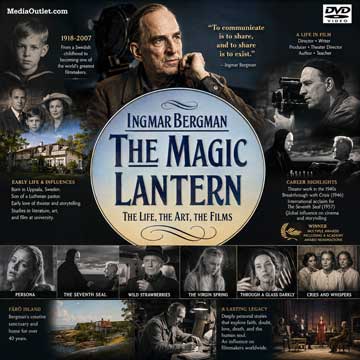
February 27: National Strawberry Day: --
We continue with February's heart-shaped and red theme by
observing National Strawberry Day on February 27th. These juicy,
sweet berries can brighten up any dish and are delicious all on
their own. There are a few different stories behind the origin of
the name. The more widely accepted version is that the berries
would drop off the leaves and become "strewn" about the
plant. Over time "strewn-berries" became "strawberries".
There was a time (and some gardeners still do this today) when
strawberry beds were mulched with straw, insulating the plants
over the winter, keeping weeds at bay during the growing season,
and making them easier to harvest. Another sweet story tells of
English children stringing the berries on grass straws and selling
the "straw berries" in their neighborhoods. Pick fully
ripe berries. Strawberries don't continue to ripen if picked too
early like bananas or pears. Don't overfill your container.
Berries are tender and can bruise easily. Don't wash the fruit
until you are ready to eat. Strawberries are susceptible to mold
and washing will speed up spoilage. The best time to pick
strawberries is on cool, cloudy days, but if they will be eaten
right away, any time is perfect! If you pick more than you can eat
before they spoil, strawberries freeze very well. Pluck off the
green caps and toss into a freezer bag. Use for smoothies, ice
cream, or cake toppings. Not only are they delicious, but they are
also fragrant. One of the more aromatic fruits, they belong to the
rose family. Strawberries are grown in nearly every corner of the
Earth (if the Earth had corners) except for her most frozen
southern and northern reaches. Along with all these possible
locations, there are over 600 varieties of strawberries as well.
An excellent source of Vitamin C, strawberries are also a good
source of folic acid, potassium, and fiber. At 55 calories and
zero fat in 1 cup, these sweet things hit the spot when snack time
is calling! So scout out strawberry festivals and pick-your-own
farms. Plan to plant your own strawberry patch. Imagine sitting in
your very own patch eating sun-warmed, sweet berries you picked or
even grew yourself under clear blue skies. Eat a strawberry! Make
a strawberry dessert. Enjoy a peanut butter and strawberry jelly
sandwich. Use #NationalStrawberryDay to post on social media! On
Sale @ 15% Off Discount Till Midnight PT!
https://store.earthstation1.com/ingmar-bergman-the-magic-lantern-dvd-biographical-documentary.html
Today's
EarthStation1.com 15% Off Commemorative Memorial Title: Great
Moments From NOVA DVD 1990 Best-Of Collection DVD, Download, USB
Today, February 27, 2026
February 27: International Polar Bear
Day: -- A yearly raising awareness of the issues facing polar
bears and the ways in which we can reduce our carbon footprint.
Climate change is a huge threat to polar bears' existence and it's
up to us to take action and protect their future. Polar bears are
classified as marine mammals, carrying with them a thick layer of
body fat and a water-repellent coat to keep them insulated against
the icy cold air and water they encounter on the sea ice of the
Arctic Ocean. With their territory melting away beneath them,
International Polar Bear Day is an important opportunity for us to
remind ourselves what is at stake here, preserving the future of
these magnificent mammals. It's been difficult for scientists to
track down the origins of the polar bear but a recent discovery in
Norway may have provided the answer. A rare jawbone found on the
Norwegian island of Svalbard in 2004 allowed scientists to
estimate that the species first walked the planet around 150,000
years ago. Indigenous cultures have lived in the Arctic and hunted
polar bears for thousands of years, contributing towards a
balanced Arctic ecosystem. That all changed in the 1700s when
hunters from Europe, Russia, and North America began to rapidly
cut into the polar bear population. Without any regulations,
people were able to trap as many polar bears as they liked, and
the species suffered because of it. By the 1950s things were
getting worse due to the increasing use of fossil fuels. The
burning of coal, oil, and gas melted the sea ice, causing ocean
levels to rise and changing the landscape of the polar bear's
environment. Environmental groups began to push back on the polar
bear's behalf but their protests often fell on deaf ears as
governments ignored their pleas to do more to protect the Arctic
and in turn polar bears. In 1973, the U.S, Denmark, Norway, and
the former USSR signed the International Agreement on the
Conservation of Polar Bears and their Habitat. The agreement
regulated commercial hunting and the U.S. government classified
polar bears as endangered. The non-profit organization Polar Bears
International (PBI) was formed in 1994 and they made it their
mission to establish action programs to protect the endangered
polar bear. They introduced the first International Polar Bear Day
in 2011 and it has been celebrated every year since. On Sale @ 15%
Off Discount Till Midnight PT!
https://store.earthstation1.com/great-moments-from-nova-dvd-1990-tv-series-be1990.html
Today's
EarthStation1.com 15% Off Commemorative Memorial Title: United
Nations Documentaries Set: 2 MP4 Downloads Or 2 DVDs
Today, February 27, 2026
February 27: World NGO Day: -- An annual
recognition of the N.G.O. (N.on-G.overnmental O.rganization).
World NGO Day is a day set aside to recognize, celebrate and honor
the fundamental contributions and profound impact that these
independent organizations have had on the world. N.G.O.s are
nonprofit organizations and although they're a modern phenomenon,
their history spans back hundreds of years. Their influence
continues to grow and make positive changes where needed in
today's world. World NGO Day was originally founded in 2009 by
Marcis Liors Skadmanis, a social entrepreneur. However, it was
observed for the first time on February 27, 2014. It's a day set
aside to honor all non-governmental and nonprofit organizations,
recognizing their impact on the world. The holiday was officially
declared back in 2010 by the 12 member countries of the Baltic Sea
NGO Forum, recognized as a partner of the Council of the Baltic
Sea States. However, it only received international recognition in
2014 by the European Union, the United Nations, and other
international organizations. An N.G.O. has been defined by the
United Nations Department of Global Communications as an
organization that is a "not-for-profit, voluntary citizen's
group that is set up at a local, national or international level
to address issues in support of the public good." Though
N.G.O.s date back to the 18th century, the name 'non-governmental
organization' was created by the 1945 Charter of the United
Nations, Article 71. Non-governmental organizations are also
referred to as civil society organizations (C.S.O.), non-profit
organizations (N.P.O.s), membership organizations, and charitable
organizations. The distinguishing factor of N.G.O.s is their
independence from the government. N.G.O.s are privately funded
through grants, private donations, membership dues, product sales,
and sometimes, government donations. Surveys indicate that there
is a high level of public trust for N.G.O.s, which makes them a
useful proxy for the concerns of society. According to the World
Bank, there are two types of N.G.O.s. These are operational
N.G.O.s and advocacy N.G.O.s. The former focuses on designing and
implementing development-related projects while advocacy N.G.O.s
promote specific causes that impact public policy. In the United
States, there are now approximately 1.5 million N.G.O.s in
existence. On Sale @ 15% Off Discount Till Midnight PT!
https://store.earthstation1.com/united-nations-documentaries-set-dvd-mp4-download-usb-driv4.html
Today's
EarthStation1.com 15% Off Commemorative Memorial Title: The Future
That Never Happened Plus Future Wars Doc MP4 Download DVD
Today, February 27, 2026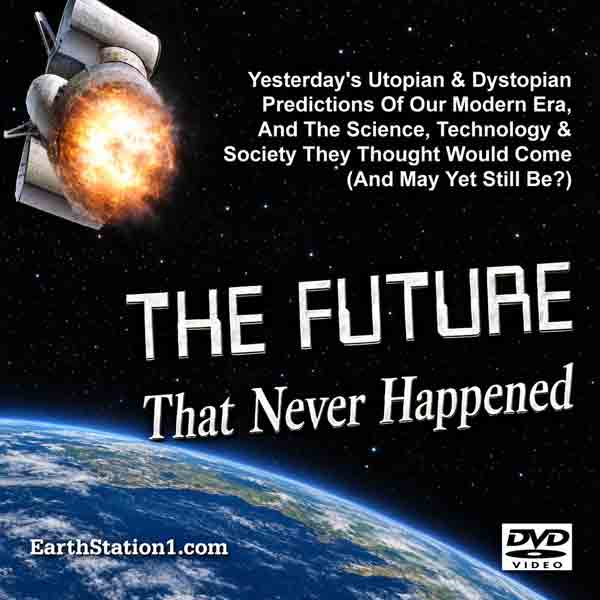
February 27: National Retro Day: -- An
annual trip back to a time before smartphones and the internet.
Every generation looks back and asks, "Remember when?"
This celebration indulges our love for the good ol' days while
remaining in the present. No matter the decade, pick a point in
time where people talked more face to face than text to text, had
dinner at home around the table and the kids played games that
didn't require internet. What's your retro? On National Retro Day,
swoop the hair into a mile-high beehive or strut those eight-inch
bell bottoms. Can you maximize the curls for a stellar Afro? Don't
hesitate to break out the old roller skates and see if you still
have those mad skills. Tie the hair up with a polka dot bandana
and strike a muscle pose like Rosie the Riveter. Maybe you prefer
a moonwalk, a leather jacket, and a single glove. With no
smartphones, internet, or social media, we spent more time focused
on each other when we were together. Each moment is recorded in
memory for us to look back retrospectively and not for the whole
world to see. Hermelinda A. Aguilar and Robert and Tina Duran
founded National Retro Day to take a look back at how life was
before social media, the internet, and smartphones became a
necessity of our daily lives. You'd expect it to have been
earlier, but better late than never! They said they came up with
this annual celebration to take a look back at how life was before
smartphones, social media, and the Internet as a whole became a
necessity in our daily lives. In pop culture, the 'nostalgia
cycle' is typically for the two decades that are 20 to 30 years
before the current one. From fashion to cars to music and beyond,
retro is a distinct style people love even now. The retro style
has been defined as "a style that is imitative or consciously
derivative of lifestyles, trends, or art forms from the historical
past, including in music, modes, fashions, or attitudes." The
term itself originated in 1972 to describe "new artifacts
that self-consciously refer to particular techniques, modes,
motifs, and materials of the past." Many people use the term
to describe styles from the past. The style refers to new things
that display characteristics of the past. The word is derived from
the Latin prefix 'retro' which means 'backward' or 'in past
times.' Retro describes objects and attitudes from the recent past
that never seem modern. What more can be said about the history of
retro? It's like a synecdoche -- something that substitutes a more
inclusive term for a less inclusive one (or vice versa). How about
the future of retro instead? Retrofuturism! It is a creative arts
movement that shows the influence of depictions of the future
produced in an earlier era. If futurism is the science of
anticipating what will come, retrofuturism is the remembering of
that anticipation. A blend of retro styles with futuristic
technology, retrofuturism explores the tension between past and
future, and also between the alienating and empowering effects of
technology. It is reflected in artistic creations by manifesting
the imagined artifacts of its parallel reality. On Sale @ 15% Off
Discount Till Midnight PT!
https://store.earthstation1.com/the-future-that-never-happened-predictions-of-our-today-dvd-mp4-us4.html
Today's
EarthStation1.com 15% Off Commemorative Memorial Title: Images Of
Jesus: Visual Art Representations Of Jesus DVD MP4 USB Drive
Today, February 27, 2026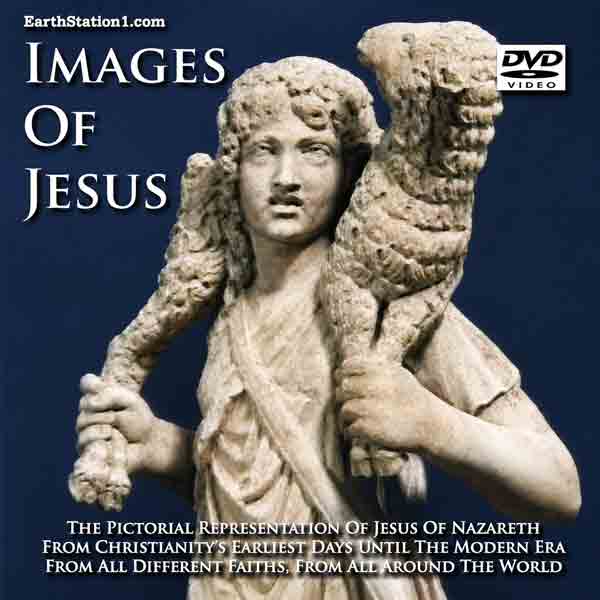
February 27, 272: #BOTD: #HBD!
Constantine I, also known as Constantine The Great, Roman emperor
(d. May 22, 337) is #born Flavius Valerius Constantinus in Naissus
(today Nis, Serbia), part of the Dardania province of Moesia.
Known in Latin as Flavius Valerius Aurelius Constantinus Augustus,
also known as Constantine I or Saint Constantine, in the Orthodox
Church as Saint Constantine The Great, Equal-to-the-Apostles, was
a Roman Emperor of Illyrian origin from 306 to 337 AD. He was the
son of Flavius Valerius Constantius, a Roman Army officer, and his
consort Helena. His father became Caesar, the deputy emperor in
the west, in 293 AD. Constantine was sent east, where he rose
through the ranks to become a military tribune under Emperors
Diocletian and Galerius. In 305, Constantius raised himself to the
rank of Augustus, senior western emperor, and Constantine was
recalled west to campaign under his father in Britannia (Britain).
Constantine was acclaimed as emperor by the army at Eboracum
(modern-day York) after his father's death in 306 AD, and he
emerged victorious in a series of civil wars against Emperors
Maxentius and Licinius to become sole ruler of both west and east
by 324 AD. As emperor, Constantine enacted administrative,
financial, social, and military reforms to strengthen the empire.
He restructured the government, separating civil and military
authorities. To combat inflation he introduced the solidus, a new
gold coin that became the standard for Byzantine and European
currencies for more than a thousand years. The Roman army was
reorganised to consist of mobile field units and garrison soldiers
capable of countering internal threats and barbarian invasions.
Constantine pursued successful campaigns against the tribes on the
Roman frontiers - the Franks, the Alamanni, the Goths, and the
Sarmatians - even resettling territories abandoned by his
predecessors during the Crisis of the Third Century. Constantine
was the first Roman emperor to convert to Christianity. On October
29, 312, Constantine entered Rome after his victory at the Battle
of the Milvian Bridge the day before, stages a grand adventus in
the city, and is met with popular jubilation. Maxentius' body is
fished out of the Tiber and beheaded. In the Battle of the Milvian
Bridge, Constantine I defeated Maxentius, becoming the sole Roman
emperor in the West. The day before the battle, Constantine had
had the Vision of the Cross, which inspired him to paint the
Christian cross on the shields of his soldiers. Constantine's
victory was to become the foundation of the Christian world that
followed thereafter. Although he lived most of his life as a
pagan, he joined the Christian faith on his deathbed, being
baptised by Eusebius. He played an influential role in the
proclamation of the Edict of Milan in 313, which declared
religious tolerance for Christianity in the Roman empire. He
called the First Council of Nicaea in 325 that produced the
statement of Christian belief known as the Nicene Creed. The
Church Of The Holy Sepulchre was built on his orders at the
purported site of Jesus' tomb in Jerusalem and became the holiest
place in Christendom. The Papal claim to temporal power in the
High Middle Ages was based on the supposed Donation of
Constantine. He is venerated as a saint by the Eastern Orthodox
and Catholic Church. He has historically been referred to as the
"First Christian Emperor," and he did heavily promote
the Christian Church. Some modern scholars, however, debate his
beliefs and even his comprehension of the Christian faith itself.
The age of Constantine marked a distinct epoch in the history of
the Roman Empire. He built a new imperial residence at Byzantium
and renamed the city Constantinople after himself (the laudatory
epithet of "New Rome" came later, and was never an
official title). It became the capital of the Empire for more than
a thousand years, with the later eastern Roman Empire now being
referred to as the Byzantine Empire by historians. His more
immediate political legacy was that he replaced Diocletian's
tetrarchy with the principle of dynastic succession by leaving the
empire to his sons. His reputation flourished during the lifetime
of his children and centuries after his reign. The medieval church
upheld him as a paragon of virtue, while secular rulers invoked
him as a prototype, a point of reference, and the symbol of
imperial legitimacy and identity. Beginning with the Renaissance,
there were more critical appraisals of his reign due to the
rediscovery of anti-Constantinian sources. Trends in modern and
recent scholarship have attempted to balance the extremes of
previous scholarship. On Sale @ 15% Off Discount Till Midnight PT!
https://store.earthstation1.com/images-of-christ-pictorial-representation-of-jesus-dvd-mp4-us4.html
Today's
EarthStation1.com 15% Off Commemorative Memorial Title:
Revelation: The History Of Christianity DVD, Video Download, USB
Drive
Today, February 27, 2026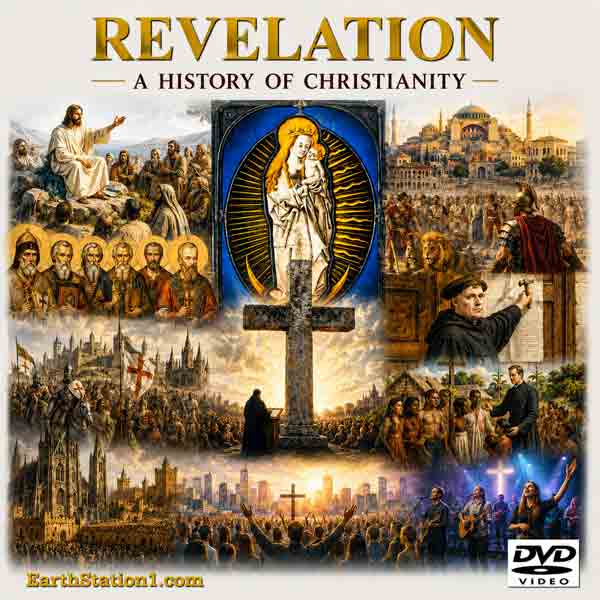
February 27, 380: Religion: The History
Of Religion: Abrahamic Religions: Christianity: Nicene Religion:
Christianity As The Roman State Religion: The Edict Of
Thessalonica (Cunctos Populos): -- Emperor Theodosius I and his
co-emperors Gratian and Valentinian II, declare their wish that
all Roman citizens convert to Nicene Christianity, a form of
Trinitarian Christianity, as members of a new state religion.
Nicene Christianity includes those Christian denominations that
adhere to the teaching of the Nicene Creed, which was formulated
at the First Council of Nicaea in AD 325 and amended at the First
Council of Constantinople in AD 381. It encompasses the vast
majority of today's Christian churches. The Edict Of Thessalonica
condemned other Christian creeds such as Arianism as heresies of
madmen, and authorized their persecution. The text of the edict is
recorded in the Codex Theodosianus, a compilation of the laws of
the Roman Empire under the Christian emperors since 312, and reads
as follows: "EMPERORS GRATIAN, VALENTINIAN AND THEODOSIUS
AUGUSTI. EDICT TO THE PEOPLE OF CONSTANTINOPLE. It is our desire
that all the various nations which are subject to our Clemency and
Moderation, should continue to profess that religion which was
delivered to the Romans by the divine Apostle Peter, as it has
been preserved by faithful tradition, and which is now professed
by the Pontiff Damasus and by Peter, Bishop of Alexandria, a man
of apostolic holiness. According to the apostolic teaching and the
doctrine of the Gospel, let us believe in the one deity of the
Father, the Son and the Holy Spirit, in equal majesty and in a
holy Trinity. We authorize the followers of this law to assume the
title of Catholic Christians; but as for the others, since, in our
judgment they are foolish madmen, we decree that they shall be
branded with the ignominious name of heretics, and shall not
presume to give to their conventicles the name of churches. They
will suffer in the first place the chastisement of the divine
condemnation and in the second the punishment of our authority
which in accordance with the will of Heaven we shall decide to
inflict. GIVEN IN THESSALONICA ON THE THIRD DAY FROM THE CALENDS
OF MARCH, DURING THE FIFTH CONSULATE OF GRATIAN AUGUSTUS AND FIRST
OF THEODOSIUS AUGUSTUS" - Codex Theodosianus, xvi.1.2.
#EdictOfThessalonica #CunctosPopulos #NiceneChristianity
#TrinitarianChristianity #Christianity #AncientRome
#WesternCulture #WesternCivilization #OccidentalCulture
#WesternWorld #WesternSociety #WesternTradition
#StoryOfCivilization #RomanEmpire #RomanHistory #StateReligion
#RomanEmperors #TheodosiusI #Gratian #ValentinianII #MP4
#VideoDownload #DVD On Sale @ 15% Off Discount Till Midnight PT!
https://store.earthstation1.com/revelation-the-history-of-christianity-documentary.html
Today's
EarthStation1.com 15% Off Commemorative Memorial Title: American
Revolutionary War Documentaries DVD, Download, USB Drive
Today, February 27, 2026
February 27, 1782: The Age Of
Enlightenment (The Enlightenment, The Age Of Reason): The Age Of
Revolution: The Atlantic Revolutions: The American Enlightenment:
The American Revolution: The American Revolutionary War: -- The
House Of Commons of Great Britain votes against further war in
America. Prime Minister Lord North's government had gained support
in Parliament after the British successes in the war at Newport
and Charleston, but the decision to allow Irish Catholics to
enlist in the army was deeply unpopular and triggered a massive
protest in London in 1780, culminating in widespread rioting. The
riots were the most destructive in London's history, damaging the
prestige of the government. On November 25, 1781, the situation
worsened when news arrived in London of the surrender at Yorktown.
Lord North is said to have repeatedly exclaimed, "Oh, God!
It's all over!". King George III received the news with
dignity, though later became depressed and considered abdication.
The Whig opposition gained traction in Parliament, and a motion
was proposed on December 12 to end the war which was defeated by
only one vote. On February 27, 1782 the House voted against
further war in America by 19 votes. Lord Germain had overseen
strategic matters in the war effort and was dismissed from office
in early 1782. Soon after, a vote of no confidence was passed
against the Prime Minister, forcing North's resignation and
leading to the collapse of his ministry. The Rockingham Whigs came
to power soon after and began opening negotiations for peace. On
Sale @ 15% Off Discount Till Midnight PT!
https://store.earthstation1.com/american-revolutionary-war-dvd-documentaries.html
Today's
EarthStation1.com 15% Off Commemorative Memorial Title: Abraham
Lincoln Documentaries Set MP4 Video Download Or DVD
Today, February 27, 2026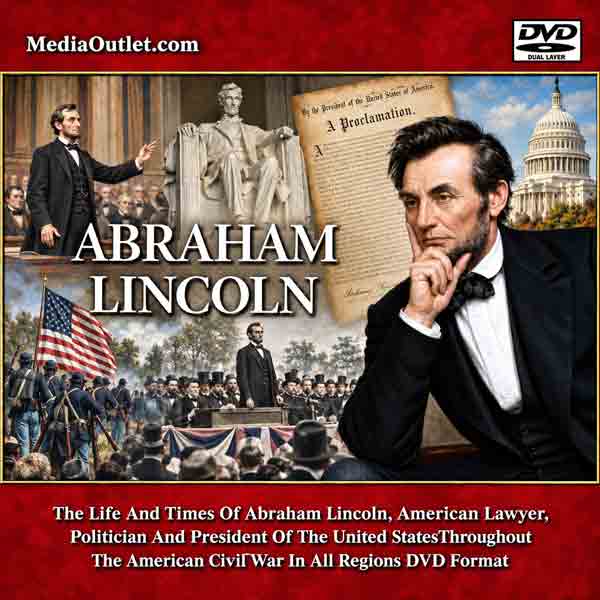
February 27, 1860: The Origins Of The
American Civil War (The Civil War, The War Between The States):
Events Leading To The American Civil War: Slavery: Slavery In The
United States: Landmark Court Decisions In The United States:
Landmark Supreme Court Of The United States (SCOTUS) Decisions:
Dred Scott v. Sandford:, The War Between The States): Events
Leading To The American Civil War: The 1860 United States
Presidential Election The Cooper Union Speech (The Cooper Union
Address, The Cooper Institute Speech): -- Abraham Lincoln delivers
a speech at The Cooper Union in the city of New York that is
largely responsible for his election to the Presidency. Lincoln
was not yet the Republican nominee for the presidency, as the
convention was scheduled for May. In the speech, Lincoln
elaborated his views on slavery by affirming that he did not wish
it to be expanded into the western territories and claiming that
the Founding Fathers would agree with this position. The
journalist Robert J. McNamara wrote, "Lincoln's Cooper Union
speech was one of his longest, at more than 7,000 words. And it is
not one of his speeches with passages that are often quoted. Yet,
due to the careful research and Lincoln's forceful argument, it
was stunningly effective.". Horace Greeley's New York Tribune
hailed it as "one of the most happiest and most convincing
political arguments ever made in this City. ...No man ever made
such an impression on his first appeal to a New-York audience."
On Sale @ 15% Off Discount Till Midnight PT!
https://store.earthstation1.com/abraham-lincoln-documentaries-dvd.html
Today's
EarthStation1.com 15% Off Commemorative Memorial Title: The
Divided Union: American Civil War TV Series MP4 Download DVD Set
Today, February 27, 2026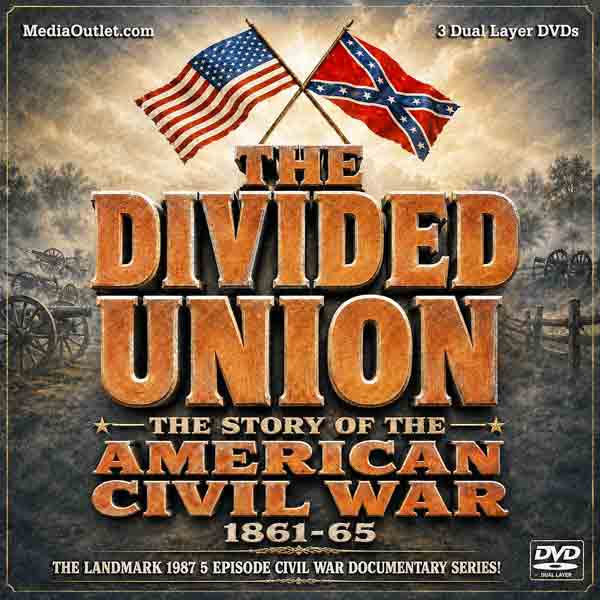
February 27, 1864: The American Civil War
(The Civil War, The War Between The States): The Eastern Theater
Of The American Civil War: Confederate Civil War Prison Camps:
Andersonville Prison (Camp Sumter, The Andersonville National
Historic Site): -- The first Northern prisoners arrive at the
notorious Confederate Camp Sumter prison, also known as
Andersonville Prison, at Andersonville, Georgia. The Andersonville
National Historic Site, located near Andersonville, Georgia,
preserves the former prisoner-of-war camp, which was used during
the final twelve months of the American Civil War. Most of the
site lies in southwestern Macon County, adjacent to the east side
of the town of Andersonville. As well as the former prison, the
site contains the Andersonville National Cemetery and the National
Prisoner of War Museum. The site is an iconic reminder of the
horrors of Civil War prisons. It was commanded by Captain Henry
Wirz, who was tried and executed after the war for war crimes. It
was overcrowded to four times its capacity, with an inadequate
water supply, inadequate food rations, and unsanitary conditions.
Of the approximately 45,000 Union prisoners held at Camp Sumter
during the war, nearly 13,000 died. The chief causes of death were
scurvy, diarrhea, and dysentery. On Sale @ 15% Off Discount Till
Midnight PT!
https://store.earthstation1.com/the-divided-union-american-civil-war-tv-series-3-dual-layer-dvd3.html
Today's
EarthStation1.com 15% Off Commemorative Memorial Title: Eyes On
The Prize II: America At The Racial Crossroads DVD MP4 USB
Today, February 27, 2026
February 27, 1886: #BOTD: Hugo Black,
American lawyer, politician, and jurist, member of the Ku Klux
Klan who left and repudiated them when he ran for senator, U.S.
Senator from Alabama from 1927 to 1937, member of the Democratic
Party and a devoted New Dealer who endorsed Franklin D. Roosevelt
in both the 1932 and 1936 presidential elections, appointed by
Roosevelt Associate Justice of the U.S. Supreme Court from 1937 to
1971 (d. September 25, 1971) is #born Hugo Lafayette Black in
Harlan, Clay County, Alabama. Before he became a Senator, Black
espoused anti-Catholic views and was a member of the Ku Klux Klan
in Alabama. An article from the Pittsburgh Post-Gazette reports
that he temporarily resigned from the Klan in 1925 to bolster his
senatorial campaign, before quietly rejoining the Klan in 1926. In
1937, upon being appointed to the Supreme Court, Black said:
"Before becoming a Senator I dropped the Klan. I have had
nothing to do with it since that time. I abandoned it. I
completely discontinued any association with the organization."
Black served as the Secretary of the Senate Democratic Conference
and the Chair of the Senate Education Committee during his decade
in the Senate. Having gained a reputation in the Senate as a
reformer, Black was nominated to the Supreme Court by President
Roosevelt and confirmed by the Senate by a vote of 63 to 16 (six
Democratic Senators and 10 Republican Senators voted against him).
He was the first of nine Roosevelt appointees to the court, and he
outlasted all except for William O. Douglas. The fifth
longest-serving justice in Supreme Court history, Black was one of
the most influential Supreme Court justices in the 20th century.
For much of his career, Black was considered strongly liberal. He
is noted for his advocacy of a textualist reading of the United
States Constitution, his position that the liberties guaranteed in
the Bill of Rights were imposed on the states ("incorporated")
by the Fourteenth Amendment, and his absolutist stance on the
First Amendment, often declaring "No law [abridging the
freedom of speech] means no law." Black expanded individual
rights in his opinions in cases such as Gideon v. Wainwright,
Engel v. Vitale, and Wesberry v. Sanders. On September 10, 1962,
Justice Black wrote the opinion of the Supreme Cout that vacated
an order of a lower court, ruling that the University Of
Mississippi had to admit James H. Meredith, a Black Air Force
veteran whose application for admission had been on file and in
the courts for fourteen months, precipitating twenty days later
The Ole Miss Riot Of 1962 (The Battle Of Oxford). Black's views
were not uniformly liberal. During World War II, he wrote the
majority opinion in Korematsu v. United States (1944), which
upheld the internment of Japanese Americans ordered by the
president Franklin Roosevelt. During the mid-1960s, Black became
slightly more conservative. Black opposed the doctrine of
substantive due process (the pre-1937 Supreme Court's
interpretation of this concept made it impossible for the
government to enact legislation that conservatives claimed
interfered with the ostensible freedom of business owners), and
believed that there was no basis in the words of the Constitution
for a right to privacy, voting against finding one in Griswold v.
Connecticut (1965). He also took conservative positions in cases
such as Shapiro v. Thompson, Goldberg v. Kelly, Tinker v. Des
Moines, and Cohen v. California where he distinguished between
"pure speech" and "expressive conduct".
Justice Black admitted himself to the National Naval Medical
Center in Bethesda, Maryland, in August 1971, and subsequently
retired from the court on September 17. He suffered a stroke two
days later and died on September 25, aged 85. Services were held
at the National Cathedral, and more than 1,000 people attended.
Pursuant to Justice Black's wishes, the coffin was "simple
and cheap" and was displayed at the service to show that the
costs of burial are not reflective of the worth of the human whose
remains were present. His remains were interred at the Arlington
National Cemetery. He is one of fourteen Supreme Court justices
buried at Arlington. The others are Harry Blackmun, William
Brennan, Arthur Goldberg, Thurgood Marshall, Potter Stewart,
William O. Douglas, Oliver Wendell Holmes Jr., John Paul Stevens,
Ruth Bader Ginsburg, Chief Justice William Howard Taft, Chief
Justice Earl Warren, Chief Justice Warren Burger, and Chief
Justice William Rehnquist. President Richard Nixon nominated Lewis
Powell to succeed Black on the Supreme Court. Powell was confirmed
by an 89 to 1 vote and was sworn in on January 7, 1972. On Sale @
15% Off Discount Till Midnight PT!
https://store.earthstation1.com/eyes-on-the-prize-ii-dvd-set-4-discs-complete-2nd-seri42.html
Today's
EarthStation1.com 15% Off Commemorative Memorial Title: TV
Commercials: The Classics Vol. 9 DVD, MP4 Download, USB Flash
Drive
Today, February 27, 2026
February 27, 1887: #DOTD: #RIP: Alexander
Borodin, Russian-Georgian chemist, professor, research scientist
and Romantic composer (b. November 12, 1833) #dies suddenly during
a ball at the Imperial Medical-Surgical Academy in Saint
Petersburg, Russia, aged 53. He is interred in Tikhvin Cemetery at
the Alexander Nevsky Monastery in Saint Petersburg. Alexander
Borodin was born Alexander Porfiryevich Borodin in Saint
Petersburg as an illegitimate son of a 62-year-old Georgian
nobleman, Luka Stepanovich Gedevanishvili, and a married
25-year-old Russian woman, Evdokia Konstantinovna Antonova. Due to
the circumstances of Alexander's birth, the nobleman had him
registered as the son of one of his Russian serfs, Porfiry
Borodin, hence the composer's Russian last name. As a result of
this registration, both Alexander and his nominal Russian father
Porfiry were officially serfs of Alexander's biological father
Luka. The Georgian father emancipated Alexander from serfdom when
he was 7 years old and provided housing and money for him and his
mother. Despite this, Alexander was never publicly recognized by
his mother, who was referred to by young Borodin as his "aunt".
Despite his status as a commoner, Borodin was well provided for by
his Georgian father and grew up in a large four-storey house,
which was gifted to Alexander and his "aunt" by the
nobleman. Although his registration prevented enrollment in a
proper gymnasium, Borodin received good education in all of the
subjects through private tutors at home. He was one of the
prominent 19th-century composers known as "The Mighty
Handful", a group dedicated to producing a uniquely Russian
kind of classical music, rather than imitating earlier Western
European models. Borodin is known best for his symphonies, his two
string quartets, the symphonic poem In the Steppes of Central Asia
and his opera Prince Igor. Music from Prince Igor and his string
quartets was later adapted for the US musical Kismet. A doctor and
chemist by profession and training, Borodin made important early
contributions to organic chemistry. Although he is presently known
better as a composer, he regarded medicine and science as his
primary occupations, only practicing music and composition in his
spare time or when he was ill. As a chemist, Borodin is known best
for his work concerning organic synthesis, including being among
the first chemists to demonstrate nucleophilic substitution, as
well as being the co-discoverer of the aldol reaction, a means of
forming carbon-carbon bonds in organic chemistry. Borodin was a
promoter of education in Russia and founded the School of Medicine
for Women in Saint Petersburg, where he taught until 1885. He
married Ekaterina Protopopova, a pianist, during 1863, and had at
least one daughter, named Gania. Music remained a secondary
vocation for Borodin besides his main career as a chemist and
physician. He suffered poor health, having overcome cholera and
several minor heart failures. On Sale @ 15% Off Discount Till
Midnight PT!
https://store.earthstation1.com/tv-commercials-the-classics-vol-9-dv9.html
Today's
EarthStation1.com 15% Off Commemorative Memorial Title: Dwight D.
Eisenhower: In War And Peace DVD, Video Download, USB Drive
Today, February 27, 2026
February 27, 1891: #BOTD: #HBD! David
Sarnoff, Belarusian-American businessman and pioneer of American
radio and television (d. December 12, 1971) is #born David Sarnov
Uzlyany to a Jewish family in Uzlyany near Minsk, Russian Empire
(present-day Belarus). Throughout most of his career he led the
Radio Corporation of America (RCA) in various capacities from
shortly after its founding in 1919 until his retirement in 1970.
He ruled over an ever-growing telecommunications and media empire
that included both RCA and NBC, and became one of the largest
companies in the world. Named a Reserve Brigadier General of the
Signal Corps in 1945, Sarnoff thereafter was widely known as "The
General." Sarnoff is credited with Sarnoff's law, which
states that the value of a broadcast network is proportional to
the number of viewers. In 1911, he installed and operated the
wireless equipment on a ship hunting seals off Newfoundland and
Labrador, and used the technology to relay the first remote
medical diagnosis from the ship's doctor to a radio operator at
Belle Isle with an infected tooth. The following year, he led two
other operators at the Wanamaker station in an effort to confirm
the fate of the Titanic. Sarnoff later exaggerated his role as a
sole hero who stayed by his telegraph key for three days to
receive information on the Titanic's survivors, and this has
largely become part of the HMS Titanic mythos. In fact, the event
began on a Sunday, when the store Sarnoff was operating from would
have been closed. Some researchers question whether Sarnoff was at
the telegraph key at all. Sarnoff also demonstrated the first use
of radio on a railroad line, the Lackawanna Railroad Company's
link between Binghamton, New York, and Scranton, Pennsylvania; and
permitted and observed Edwin Armstrong's demonstration of his
regenerative receiver at the Marconi station at Belmar, New
Jersey, a landmark event in the history of radio signal
transmission. Sarnoff used H. J. Round's hydrogen arc transmitter
to demonstrate the broadcast of music from the New York Wanamaker
station. Sarnoff was instrumental in building and establishing the
AM broadcasting radio business that became the preeminent public
radio standard for the majority of the 20th century. This
technology dominance continued until FM broadcasting radio
re-emerged in the 1960s despite Sarnoff's efforts to suppress it;
ironically, it was Sarnoff who was responsible for funding his
friend and business partner Edwin Armstrong's work atop the Empire
State Buidling in New York City to invent FM radio, but once
Armstrong invented it and demonstrated it to Sarnof, Sarnoff
realized it threatened his AM-based radio network, and he began a
long and tragic battle against FM radio generally, and Armstrong
particularly, a battle which he belatedly and inevitably conceded.
He was the most successful of all commercial broadcasting pioneers
of the twentieth century. David Sarnoff died in New York City of
heart failure related to shingles, aged 80. He is interred in a
mausoleum featuring a stained-glass vacuum tube in Kensico
Cemetery in Valhalla, New York. After his death, Sarnoff left
behind an estate estimated to be worth over 1M USD. The majority
of the estate went to his widow, Lizette Hermant Sarnoff, who
received 300K USD, personal and household effects, and the Sarnoff
home, located on 44 East 71st Street. On Sale @ 15% Off Discount
Till Midnight PT!
https://store.earthstation1.com/dwight-d-eisenhower-documentaries-dual-layer-dvd.html
Today's
EarthStation1.com 15% Off Commemorative Memorial Title: Marian
Anderson Documentary DVD, MP4 Video Download, USB Flash Drive
Today, February 27, 2026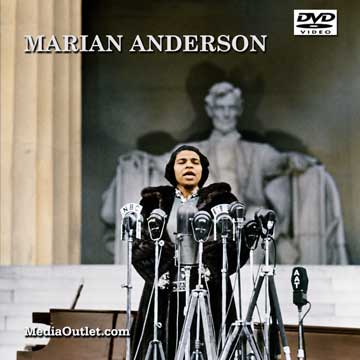
February 27, 1897: #BOTD: #HBD! Marian
Anderson, African American contralto and one of the most
celebrated singers of the twentieth century (d. April 8, 1993) is
#born in Philadelphia, Pennsylvania. Music critic Alan Blyth said:
"Her voice was a rich, vibrant contralto of intrinsic
beauty", and Arturo Toscanini praised her voice as one "heard
once in a hundred years". Most of her singing career was
spent performing in concert and recital in major music venues and
with famous orchestras throughout the United States and Europe
between 1925 and 1965. Although offered roles with many important
European opera companies, Anderson declined, as she had no
training in acting. She preferred to perform in concert and
recital only. She did, however, perform opera arias within her
concerts and recitals. She made many recordings that reflected her
broad performance repertoire of everything from concert literature
to lieder to opera to traditional American songs and spirituals.
Between 1940 and 1965 the German-American pianist Franz Rupp was
her permanent accompanist. Anderson became an important figure in
the struggle for black artists to overcome racial prejudice in the
United States during the mid-twentieth century. In 1939, the
Daughters of the American Revolution (DAR) refused permission for
Anderson to sing to an integrated audience in Constitution Hall.
The incident placed Anderson into the spotlight of the
international community on a level unusual for a classical
musician. With the aid of First Lady Eleanor Roosevelt and her
husband Franklin D. Roosevelt, Anderson performed a critically
acclaimed open-air concert on Easter Sunday, April 9, 1939, on the
steps of the Lincoln Memorial in Washington, D.C. She sang before
a crowd of more than 75,000 people and a radio audience in the
millions. Anderson continued to break barriers for black artists
in the United States, becoming the first black person, American or
otherwise, to perform at the Metropolitan Opera in New York City
on January 7, 1955. Her performance as Ulrica in Giuseppe Verdi's
Un ballo in maschera at the Met was the only time she sang an
opera role on stage. Anderson worked for several years as a
delegate to the United Nations Human Rights Committee and as a
"goodwill ambassadress" for the United States Department
of State, giving concerts all over the world. She participated in
the civil rights movement in the 1960s, singing at the March on
Washington for Jobs and Freedom in 1963. The recipient of numerous
awards and honors, Anderson was awarded the Presidential Medal Of
Freedom in 1963, the Congressional Gold Medal in 1977, the Kennedy
Center Honors in 1978, the National Medal of Arts in 1986, and a
Grammy Lifetime Achievement Award in 1991. Marian Anderson died of
congestive heart failure at the age of 96 at the home of her
nephew, conductor James DePreist, in Portland, Oregon, where she
had relocated. She is interred at Eden Cemetery, in Collingdale,
Pennsylvania. On Sale @ 15% Off Discount Till Midnight PT!
https://store.earthstation1.com/marian-anderson-dvd-documentary.html
Today's
EarthStation1.com 15% Off Commemorative Memorial Title: NBC
University Theater Of The Air Literature Radio Series MP3 DVD USB
Today, February 27, 2026
February 27, 1902: #BOTD: #HBD! John
Steinbeck, American journalist, novelist and short story writer,
Nobel Prize laureate (d. December 20, 1968) is #born John Ernst
Steinbeck Jr. in Salinas, California. He was awarded the 1962
Nobel Prize in Literature "for his realistic and imaginative
writings, combining as they do sympathetic humour and keen social
perception." He has been called "a giant of American
letters," and many of his works are considered classics of
Western literature. During his writing career, he authored 33
books, including 16 novels, six non-fiction books, and two
collections of short stories. He is widely known for the comic
novels Tortilla Flat (1935) and Cannery Row (1945), the
multi-generation epic East of Eden (1952), and the novellas Of
Mice and Men (1937) and The Red Pony (1937). The Pulitzer
Prize-winning The Grapes Of Wrath (1939) is considered Steinbeck's
masterpiece and part of the American literary canon. In the first
75 years after it was published, it sold 14 million copies. Most
of Steinbeck's work is set in central California, particularly in
the Salinas Valley and the California Coast Ranges region. His
works frequently explored the themes of fate and injustice,
especially as applied to downtrodden or everyman protagonists.
John Steinbeck died in New York City during the 1968 flu pandemic
of heart disease and congestive heart failure. He was 66, and had
been a lifelong smoker. An autopsy showed nearly complete
occlusion of the main coronary arteries. In accordance with his
wishes, his body was cremated, and interred on March 4, 1969 at
the Hamilton family gravesite in Salinas, California with those of
his parents and maternal grandparents. His third wife, Elaine, was
buried in the plot in 2004. He had written to his doctor that he
felt deeply "in his flesh" that he would not survive his
physical death, and that the biological end of his life was the
final end to it. On Sale @ 15% Off Discount Till Midnight PT!
https://store.earthstation1.com/nbc-university-theater-of-the-air-otr-mp3-dv3.html
Today's
EarthStation1.com 15% Off Commemorative Memorial Title: LBJ 1991
TV Documentary Series Lyndon Johnson DVD Download USB Drive
Today, February 27, 2026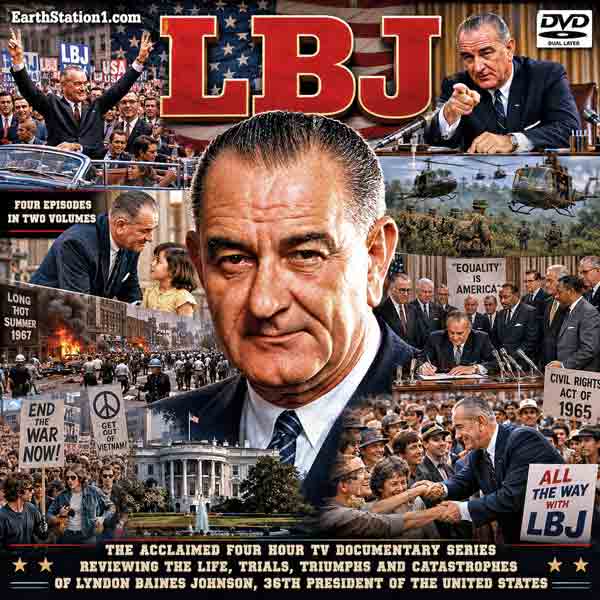
February 27, 1917: #BOTD: #HBD! John
Connally, American commander, lawyer, and politician, 39th
Governor of Texas and 61st United States Secretary of the Treasury
who was seriously wounded when President Kennedy was assassinated
(d. June 15, 1993) is #born John Bowden Connally Jr. into a large
family in Floresville, the seat of Wilson County, southeast of San
Antonio, Texas. He began his career as a Democrat but switched to
the Republican Party in 1973. Born in Floresville, Texas, Connally
pursued a legal career after graduating from the University of
Texas at Austin. During World War II, he served on the staff of
James Forrestal and Dwight D. Eisenhower before transferring to
the Asiatic-Pacific Theater. After the war, he became an aide to
Senator Lyndon B. Johnson. When Johnson assumed the vice
presidency in 1961, he convinced President John F. Kennedy to
appoint Connally to the position of United States Secretary of the
Navy. Connally left the Kennedy Administration in December 1961 to
run for Governor of Texas, and he held that position from 1963 to
1969. Connally was seriously wounded in November 1963 during the
assassination of Kennedy. In 1971, Republican President Richard
Nixon appointed Connally as his Treasury Secretary. In this
position, Connally presided over the removal of the U.S. dollar
from the gold standard, an event known as the Nixon shock.
Connally stepped down from the Cabinet in 1972 to lead the
Democrats for Nixon organization, which campaigned for Nixon's
re-election. Connally was a candidate to replace Vice President
Spiro Agnew after the latter resigned in 1973, but Nixon chose
Gerald Ford instead. Connally sought the Republican nomination for
president in the 1980 election, but withdrew from the race after
the first set of primaries. Connally did not seek public office.
John Connally died in Houston, Texas from pulmonary fibrosis at
the age of 76. When Connally died, forensic pathologist Dr. Cyril
Wecht and the Assassination Archives and Research Center
petitioned Attorney General Janet Reno to recover the remaining
bullet fragments from Connally's body, contending that the
fragments would disprove the Warren Commission's single-bullet,
single-gunman conclusion. The Justice Department replied that it
"...would have no legal authority to recover the fragments
unless Connally's family gave it permission." Connally's
family refused permission. His funeral was held on June 17, 1993
at the First United Methodist Church of Austin where he and his
wife, Nellie Connally, had been members since 1963. Former
President Nixon was in attendance. Connally's wife Nellie died in
2006; they are interred together at the Texas State Cemetery in
Austin, Texas. On Sale @ 15% Off Discount Till Midnight PT!
https://store.earthstation1.com/lbj-1991-tv-documentary-series-lyndon-johnson-dvd-download-usb-d1991.html
Today's
EarthStation1.com 15% Off Commemorative Memorial Title: Satchmo:
Louis Armstrong Biography + Bonus Title DVD MP4 USB Drive
Today, February 27, 2026
February 27, 1923: #BOTD: #HBD! Dexter
Gordon, African American jazz tenor saxophonist, composer, and
actor (d. April 25, 1990) is #born Dexter Keith Gordon in Los
Angeles, California. He was one of the first players of the
instrument in the bebop idiom of musicians such as Charlie Parker,
Dizzy Gillespie, and Bud Powell. Gordon's height was 6 feet 6
inches (198 cm), so he was also known as "Long Tall Dexter"
and "Sophisticated Giant". His studio and performance
career spanned over 40 years. Gordon's sound was commonly
characterized as being "large" and spacious and he had a
tendency to play behind the beat. He was known for humorously
inserting musical quotes into his solos, with sources as diverse
as popular tunes, "Happy Birthday", and the operas of
Wagner. This is not unusual in common-practice jazz improvisation,
but Gordon did it frequently enough to make it a hallmark of his
style. One of his major influences was Lester Young. Gordon, in
turn, was an early influence on John Coltrane and Sonny Rollins.
Rollins and Coltrane then influenced Gordon's playing as he
explored hard bop and modal playing during the 1960s. Gordon was
known for his genial and humorous stage presence. He was an
advocate of playing to communicate with the audience.[2] A
photograph by Herman Leonard of Gordon taking a smoke break at the
Royal Roost in 1948 is one of the iconic images in jazz
photography. Cigarettes were a recurring theme on covers of
Gordon's albums. One of his idiosyncratic rituals was to recite
lyrics from each ballad before playing it. Gordon was nominated
for an Academy Award for Best Actor in a Leading Role for his
performance in the Bertrand Tavernier film Round Midnight (Warner
Bros, 1986), and he won a Grammy for Best Jazz Instrumental
Performance, Soloist, for the soundtrack album The Other Side of
Round Midnight (Blue Note Records, 1986). He also had a cameo role
in the 1990 movie Awakenings. On Sale @ 15% Off Discount Till
Midnight PT!
https://store.earthstation1.com/satchmo-louis-armstrong-biography-dvd-mp4-usb-driv4.html
Today's
EarthStation1.com 15% Off Commemorative Memorial Title: Clive
James' Fame In The 20th Century TV Series DVD Set MP4 USB Drive
Today, February 27, 2026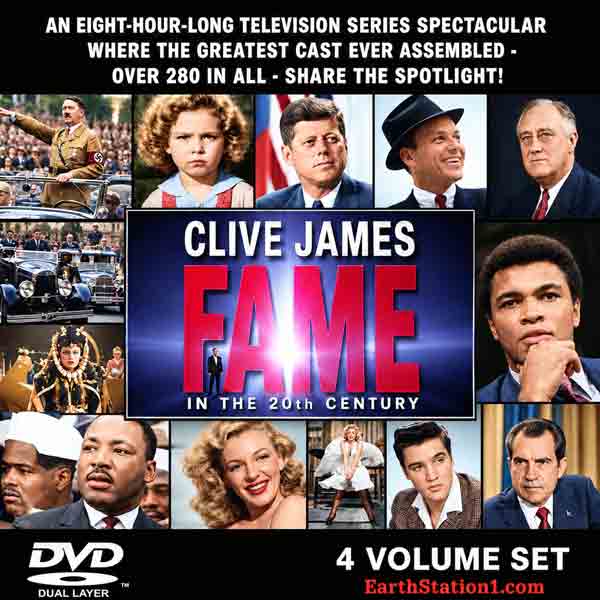
February 27, 1932: #BOTD: #HBD! Elizabeth
Taylor, English-American actress, businesswoman, socialite,
humanitarian and beauty (d. March 23, 2011) is #born Elizabeth
Rosemond Taylor in London, England to socially prominent American
parents. Dame Elizabeth Rosemond Taylor DBE began her career as a
child actress in the early 1940s and was one of the most popular
stars of classical Hollywood cinema in the 1950s. She continued
her career successfully into the 1960s, remaining a well-known
public figure for the rest of her life. In 1999, the American Film
Institute named her the seventh-greatest female screen legend of
all time. Taylor moved with her family to Los Angeles in 1939. She
made her acting debut with a minor role in the Universal Pictures
film There's One Born Every Minute (1942), but the studio ended
her contract after a year. She was then signed by
Metro-Goldwyn-Mayer and became a popular teen star after appearing
in National Velvet (1944). She transitioned to mature roles in the
1950s, when she starred in the comedy Father of the Bride (1950)
and received critical acclaim for her performance in the drama A
Place in the Sun (1951). Despite being one of MGM's most bankable
stars, Taylor wished to end her career in the early 1950s. She
resented the studio's control and disliked many of the films to
which she was assigned. She began receiving more enjoyable roles
in the mid-1950s, beginning with the epic drama Giant (1956), and
starred in several critically and commercially successful films in
the following years. These included two film adaptations of plays
by Tennessee Williams: Cat on a Hot Tin Roof (1958), and Suddenly,
Last Summer (1959); Taylor won a Golden Globe for Best Actress for
the latter. Although she disliked her role as a call girl in
Butterfield 8 (1960), her last film for MGM, she won the Academy
Award for Best Actress for her performance. During the production
of the film Cleopatra in 1961, Taylor and co-star Richard Burton
began an extramarital affair, which caused a scandal. Despite
public disapproval, they continued their relationship and were
married in 1964. Dubbed "Liz and Dick" by the media,
they starred in 11 films together, including The V.I.P.s (1963),
The Sandpiper (1965), The Taming of the Shrew (1967), and Who's
Afraid of Virginia Woolf? (1966). Taylor received the best reviews
of her career for Woolf, winning her second Academy Award and
several other awards for her performance. She and Burton divorced
in 1974, but reconciled soon after, and remarried in 1975. The
second marriage ended in divorce in 1976. Taylor's acting career
began to decline in the late 1960s, although she continued
starring in films until the mid-1970s, after which she focused on
supporting the career of her sixth husband, United States Senator
John Warner (R-Virginia). In the 1980s, she acted in her first
substantial stage roles and in several television films and
series. She also became the first celebrity to launch a perfume
brand. Taylor was one of the first celebrities to take part in
HIV/AIDS activism. She co-founded the American Foundation for AIDS
Research in 1985 and the Elizabeth Taylor AIDS Foundation in 1991.
From the early 1990s until her death, she dedicated her time to
philanthropy, for which she received several accolades, including
the Presidential Citizens Medal. Throughout her career, Taylor's
personal life was the subject of constant media attention. She was
married eight times to seven men, converted to Judaism, endured
several serious illnesses, and led a jet set lifestyle, including
assembling one of the most expensive private collections of
jewelry in the world. Elizabeth Taylor died after many years of
ill health at the Cedars-Sinai Medical Center in Los Angeles.from
congestive heart failure at the age of 79. She is buried at Forest
Lawn Memorial Park in Glendale, Los Angeles, California. Her dying
wish was to be buried alongside her last ever love letter from
Richard Burton, which was penned by the actor prior to his sudden
death in 1984 aged 58, after having kept the letter next to her
for the 27 years prior to her death. She told her biographers Sam
Kashner and Nancy Schoenberger: "In it he told me what he
wanted. Home was where Elizabeth was, and he wanted to come home."
On Sale @ 15% Off Discount Till Midnight PT!
https://store.earthstation1.com/clive-james39-fame-in-the-20th-century-tv-series-dvd-set-mp4-usb-39204.html
Today's
EarthStation1.com 15% Off Commemorative Memorial Title: Hitler
(1963) Richard Basehart Maria Emo MP4 Video Download DVD
Today, February 27, 2026
February 27, 1933: The Interwar Period
(The Interbellum, Between The Wars): Nazi Germany (The German
Reich, The Third Reich): False Flag Operations: The Reichstag Fire
(German: Reichstagsbrand): -- Germany's parliament building in
Berlin, The Reichstag, is set on fire; Marinus van der Lubbe, a
Dutch council communist, was the alleged culprit; however, Hitler
attributed the fire to Communist agitators, and the consensus of
modern historians is that the fire was set by the Nazis under
Herman Goering's supervision as a false flag operation in order to
blame the communists, persecute them, and consolidate Hitler's
power over Germany. The Nazis used the fire to solidify their
power and eliminate the communists as political rivals. The
Reichstag fire (German: Reichstagsbrand) was an arson attack on
the Reichstag building, the home of the German parliament in
Berlin, just one month after Adolf Hitler had been sworn in as
Chancellor of Germany. The Nazis publicly blamed the fire on
communist agitators in general, although in a German court in
1933, it was decided that Van Der Lubbe had acted alone, as he
claimed to have done. After the fire, the Reichstag Fire Decree
was passed. The fire was used as evidence by the Nazi Party that
communists were plotting against the German government. The event
is seen as pivotal in the establishment of Nazi Germany. Hitler
urged President Paul von Hindenburg to pass an emergency decree to
suspend civil liberties and pursue a "ruthless confrontation"
with the Communist Party of Germany. After passing the decree, the
government instituted mass arrests of communists, including all of
the Communist Party parliamentary delegates. With their bitter
rival communists gone and their seats empty, the Nazi Party went
from being a plurality party to the majority, thus enabling Hitler
to consolidate his power. Three men were arrested who were to play
pivotal roles during the Leipzig Trial, known also as the
"Reichstag Fire Trial": Bulgarians Georgi Dimitrov,
Vasil Tanev and Blagoy Popov. The Bulgarians were known to the
Prussian police as senior Comintern operatives, but the police had
no idea how senior they were: Dimitrov was head of all Comintern
operations in Western Europe. The responsibility for the Reichstag
fire remains an ongoing topic of debate and research. Historians
disagree as to whether van der Lubbe acted alone, as he said, to
protest the condition of the German working class. The Nazis
accused the Comintern of the act. The responsibility for the
Reichstag fire remains a topic of debate and research. The
consensus of modern historians, based on archive evidence, is that
the arson had been planned and ordered by the Nazis as a false
flag operation. The building remained in its damaged state until
it was partially repaired from 1961 to 1964 and completely
restored from 1995 to 1999. On Sale @ 15% Off Discount Till
Midnight PT!
https://store.earthstation1.com/hitler-1963-richard-basehart-maria-emo-mp4-video-download-dvd.html
Today's
EarthStation1.com 15% Off Commemorative Memorial Title: Our
Neighbor Fred Rogers: Mister Rogers' Neighborhood DVD, MP4, USB
Today, February 27, 2026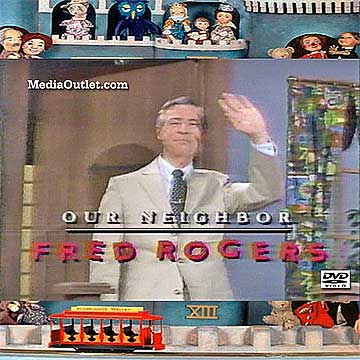
February 27, 2003: #DOTD: #RIP: Fred
Rogers, American television personality, musician, puppeteer,
writer and Presbyterian minister, host and producer of Mister
Roger's Neighborhood (b. March 20, 1928) #dies of stomach cancer
at his home in Pittsburgh, with his wife of 50 years, Joanne, at
his side, aged 74. He was born Fred McFeely Rogers in Latrobe,
Pennsylvania. Fred Rogers was famous for creating, hosting, and
composing the theme music for the educational preschool television
series Mister Rogers' Neighborhood (1968-2001), which featured his
kind-hearted, grandfatherly personality, and directness to his
audiences. Initially educated to be a minister, Rogers was
displeased with the way television addressed children and made an
effort to change this when he began to write for and perform on
local Pittsburgh-area shows dedicated to youth. WQED developed his
own show in 1968 and it was distributed nationwide by Eastern
Educational Television Network. Over the course of three decades
on television, Fred Rogers became an icon of American children's
entertainment and education. He was also known for his advocacy of
various public causes. His testimony before a lower court in favor
of fair-use recording of television shows to play at another time
(now known as time shifting) was cited in a U.S. Supreme Court
decision on the Betamax case, and he gave now-famous testimony to
a U.S. Senate committee, advocating government funding for
children's television. Rogers received the Presidential Medal Of
Freedom, some forty honorary degrees, and a Peabody Award. He was
inducted into the Television Hall of Fame, was recognized by two
Congressional resolutions, and was ranked No. 35 among TV Guide's
Fifty Greatest TV Stars of All Time. Several buildings and
artworks in Pennsylvania are dedicated to his memory, and the
Smithsonian Institution displays one of his trademark sweaters as
a "Treasure of American History". On June 25, 2016, the
Fred Rogers Historical Marker was placed near Latrobe,
Pennsylvania, and was named and dedicated in his memory. On Sale @
15% Off Discount Till Midnight PT!
https://store.earthstation1.com/our-neighbor-fred-rogers-mister-rogers39-neighborhood-d39.html
Today's
EarthStation1.com #OnThisDay Commemorative Memorial Title: 1960
Democratic & Republican National Conventions DVD MP4 USB Drive
Today, February 27, 2026 February 27, 1985: #DOTD: Henry Cabot
Lodge Jr., American politician and diplomat, 3rd United States
Ambassador to the United Nations in the administration of
President Dwight D. Eisenhower, Republican nominee for Vice
President on the ticket with two-term Vice President of President
Dwight D. Eisenhower Richard Nixon, who though narrowly lost to
Democrats John F. Kennedy and Lyndon B. Johnson later served as a
diplomat in the Kennedy and Johnson administrations as well as
that of Nixon and Gerald Ford., 1964 Republican candidate
contender (b. July 5, 1902) #dies in Beverly, Massachusetts, aged
82, after a long unspecified illness. He is interred in the Mount
Auburn Cemetery in Watertown, Massachusetts. Two years after
Lodge's death, his widow Emily Sears married Forrester A. Clark.
She died in 1992 of lung cancer and is interred near her first
husband in the Cabot Lodge family columbarium (a structure for the
reverential and usually public storage of funerary urns holding
cremated remains of the dead). Henry Cabot Lodge Jr. was born in
Nahant, Massachusetts, Lodge was the grandson of Senator Henry
Cabot Lodge and the great-grandson of Secretary of State Frederick
Theodore Frelinghuysen. After graduating from Harvard University,
Lodge won election to the Massachusetts House of Representatives.
He defeated Democratic governor James Michael Curley in 1936 to
represent Massachusetts in the United States Senate. He resigned
from the Senate in 1944 to serve in Italy and France during World
War II. Lodge remained in the Army Reserve after the war and
eventually rose to the rank of major general. In 1946, Lodge
defeated incumbent Democratic Senator David I. Walsh to return to
the Senate. He led the Draft Eisenhower movement before the 1952
election and managed Eisenhower's successful campaign for the
Republican presidential nomination at the 1952 Republican National
Convention. Eisenhower defeated Democratic nominee Adlai Stevenson
II in the general election, but Lodge lost his own re-election
campaign to then-Congressman Kennedy. Lodge was named as
ambassador to the United Nations in 1953 and became a member of
Eisenhower's Cabinet. Vice President Nixon chose Lodge as his
running mate in the 1960 presidential election, but the Republican
ticket lost the close election. In 1963, the now-President Kennedy
appointed Lodge to the position of Ambassador to South Vietnam,
where Lodge supported the 1963 South Vietnamese coup. In 1964,
Lodge won by a plurality a number of that year's party
presidential primaries and caucuses on the strength of his name,
reputation, and respect among many voters, though the nomination
went to Barry Goldwater. This effort was encouraged and directed
by low-budget but high-impact grassroots campaign by academic and
political amateurs. He continued to represent the United States in
various countries under Presidents Johnson, Nixon, and Ford. Lodge
led the U.S. delegation that signed the Paris Peace Accords with
North Vietnam, leading to the end of the Vietnam War.
https://store.earthstation1.com/1960-democratic-and-republican-national-conventions1960.html
Today's
EarthStation1.com #OnThisDay Commemorative Memorial Title: The Bad
Lord Byron (1949) Docudramatic Biography DVD, MP4, USB Drive
Today, February 27, 2026February 27, 1812: The Industrial
Revolution: The First Industrial Revolution (1760 - c. 1840): The
History Of The Textile Industry: The History Of The Textile
Industry In The United Kingdom: The Luddites: The Political Career
Of Lord Byron: -- Lord Byron gives his first address as a member
of the House of Lords, the upper house of the Parliament of the
United Kingdom, in defense of Luddite violence against
Industrialism in his home county of Nottinghamshire, denouncing
the plight of the working class, the government's inane policies
and ruthless repression: "I have been in some of the most
oppressed provinces of Turkey; but never, under the most despotic
of infidel governments, did I behold such squalid wretchedness as
I have seen since my return, in the very heart of a Christian
country". Specifically, he was against the passage of a
proposed law to issue the death penalty for Luddite "frame
breakers" in Nottinghamshire, who destroyed textile machines
that were putting them out of work. His speech was loaded with
sarcastic references to the "benefits" of automation,
which he saw as producing inferior material as well as putting
people out of work, and concluded the proposed law was only
missing two things to be effective: "Twelve Butchers for a
Jury and a Jeffries for a Judge!", the latter a reference to
George Jeffreys, 1st Baron Jeffreys PC (May 15, 1645 - April 18,
1689), a Welsh judge with a historical reputation for severity and
bias nicknamed "The Hanging Judge" and "The Bloody
Judge", who became notable as Lord Chancellor and Lord High
Steward during the reign of King James II. Byron's speech was
officially recorded and printed in Hansard, the publication of
Thomas Curson Hansard of the transcripts of parliamentary debates
in Britain and many Commonwealth countries. Byron said later that
he "spoke very violent sentences with a sort of modest
impudence" and thought he came across as "a bit
theatrical". The Luddites were a group of English textile
workers and weavers in the 19th century who destroyed weaving
machinery as a form of protest. The group was protesting the use
of machinery in a "fraudulent and deceitful manner" to
get around standard labour practices. Luddites feared that the
time spent learning the skills of their craft would go to waste as
machines would replace their role in the industry. It is a
misconception that the Luddites protested against the machinery
itself in an attempt to halt the progress of technology. Over
time, however, the term has come to mean one opposed to
industrialisation, automation, computerisation, or new
technologies in general. The Luddite movement began in Nottingham
and culminated in a region-wide rebellion that lasted from 1811 to
1816. Mill owners took to shooting protesters and eventually the
movement was suppressed with military force.
https://store.earthstation1.com/the-bad-lord-byron-19491949.html
Today's
EarthStation1.com #OnThisDay Commemorative Memorial Title: The
Telegoons TV Series All 26 Goon Shows DVD, MP4 Download, USB Stick
Today, February 27, 2026February 27, 2002: #DOTD: #RIP: Spike
Milligan, British-Irish comedian, writer, musician, poet,
playwright and actor (b. April 16, 1918) #dies of kidney failure
at the age of 83 at his home near Rye, Sussex. Even late in life,
Milligan's black humour had not deserted him. After the death of
Harry Secombe from cancer, he said, "I'm glad he died before
me, because I didn't want him to sing at my funeral." (A
recording of Secombe singing was played at Milligan's memorial
service.) He also wrote his own obituary, in which he stated
repeatedly that he "wrote the Goon Show and died". On
the day of his March 8, 2002 funeral, his coffin was carried to St
Thomas Church in Winchelsea, East Sussex, and was draped in the
flag of Ireland. He had once quipped that he wanted his headstone
to bear the words "I told you I was ill." He was buried
at St Thomas' churchyard but the Chichester diocese refused to
allow this epitaph. A compromise was reached with the Irish
translation of "I told you I was ill", Duirt me leat go
raibh me breoite and in English, "Love, light, peace".
The additional epitaph "Gra mhor ort Shelagh" can be
read as "Great love for you Shelagh", referring to his
wife. According to a letter published in the Rye and Battle
Observer in 2011, Milligan's headstone was removed from St Thomas'
churchyard in Winchelsea and moved to be alongside the grave of
his wife, but was later returned. He was born Terence Alan
Milligan in Ahmednagar, India, the son of an Irish father, Captain
Leo Alphonso Milligan, MSM, RA (1890-1969), who was serving in the
British Indian Army, and Florence Mary Winifred (nee Kettleband;
1893-1990), was English. He is considered by many to have been
Great Britain's greatest comedian of the twentieth century.
Millligan spent his early life in India where he was born. The
majority of his working life was spent in the United Kingdom. He
disliked his first name, and began to call himself "Spike"
after hearing Spike Jones and his City Slickers on Radio
Luxembourg. He is most famous as the co-creator, main writer and a
principal cast member of the groundbreaking British radio
programme, The Goon Show, performing a range of roles including
the popular Eccles and Minnie Bannister characters. The Goon Show
also starred Peter Sellers, Harry Secombe and Michael Bentine.
Milligan wrote and edited many books, including Puckoon and his
seven-volume autobiographical account of his time serving during
the Second World War, beginning with Adolf Hitler: My Part in His
Downfall. He is also noted as a popular writer of comical verse;
much of his poetry was written for children, including Silly Verse
for Kids (1959). After success with The Goon Show, Milligan
translated this success to television with the Q series of
television shows (Q5, Q6, Q7, Q8 ,etc.) which were surreal sketch
shows that were a primary inspiration for Monty Python' Flying
Circus. He was the earliest-born, longest-lived and last surviving
member of the Goons. His producer, George Martin, was also the
producer of The Beatles, whose humor was largely inspired by the
Goon Shows they listened to when growing up in Liverpool. When the
Commonwealth Immigrants Act removed Indian-born Milligan's
automatic right to British citizenship in 1962, he became an Irish
citizen, exercising a right conferred through his Irish-born
father.
https://store.earthstation1.com/the-telegoons-2-dual-layer-dvds-goon-show-puppet-tv-serie2.html
Today's
EarthStation1.com #OnThisDay Commemorative Memorial Title: The
Goon Show British Radio Comedy Series MP3 DVD, Download, USB Drive
Today, February 27, 2026February 27, 1985: #DOTD: #RIP: Ray
Ellington, popular Jewish African English singer, drummer,
bandleader and comedian, best known for his appearances on The
Goon Show from 1951 to 1960 (b. March 17, 1916) #dies of cancer in
London, England, aged 68. He was both cremated and buried at
Golders Green Crematorium, Golders Green, London, England. Ray
Ellington was born Henry Pitts Brown at 155 Kennington Road,
Kennington, London, England. The Ray Ellington Quartet had a
regular musical segment on the show, and Ellington also had a
small speaking role in many episodes, often as a parodic African,
Native American or Arab chieftain (but also often, with no attempt
to change his normal accent, in counter-intuitive roles such as a
female secretary or a Scotsman). He was the youngest of the four
children of Harry Pitts Brown (c.1877-1920), an African American
music-hall comedian and entertainer, and Eva Stenkell Rosenthal
(b. c.1879), a Russian Jew. His father died when Brown was four
years old. Ellington was brought up as a strictly Orthodox Jew and
attended the South London Jewish School (1924-30), before entering
show business at the age of twelve, when he appeared in an acting
role on the London stage. Ellington's first break came in 1937
when he joined Harry Roy and His Orchestra as the band's drummer,
replacing Joe Daniels. His vocal talents were put to good use too,
from the time of his first session when he recorded "Swing
for Sale." Ellington was called up in May 1940 when he joined
the Royal Air Force (RAF) as a physical training instructor where
he served throughout the war. He played in various service bands
including RAF Blue Eagles (1945). After demobilisation, Ellington
resumed his career, fronting his own group, playing at The Bag
O'Nails club. Early in 1947, he rejoined the Harry Roy band for a
few months. The Ray Ellington Quartet was formed in the same year.
Ellington specialised in jazz but experimented with many other
genres throughout the show's history and his musical style was
heavily influenced by the comedic jump blues of Louis Jordan.
Ellington's band was one of the first in the UK to feature the
stripped-back guitar/bass/drums/piano format that became the basis
of rock and roll, as well as being one of the first groups in
Britain to prominently feature the electric guitar. They were also
reputedly the first jazz band in the UK to use an amplified
guitar, which was produced and introduced by their guitar player,
Lauderic Caton. The other members of Ellington's quartet were Dick
Katz (piano) and Coleridge Goode (bass). When guitarist Caton
moved on he was succeeded in turn by Laurie Deniz, Australian Don
Fraser and Judd Proctor, who was a member of the quartet for six
years from July 1955. Early in The Goon Show's run, there were
many jokes linking Ellington to the African nation of Ghana, thus
leading Ellington to say that he came from Ghana. Ellington's
recording of "The Madison" reached No. 36 in the UK
Singles Chart in November 1962. He was married to Anita West, who
was to become the second female presenter of Blue Peter when she
replaced Leila Williams, but she only lasted a few months in this
role. They had two young children (Lance and Nina) when the
marriage ended in divorce. Ray's son Lance Ellington is a singer
who has recorded several jazz-orientated albums, and is one of the
backing singers in the BBC show Strictly Come Dancing. Lance
Ellington also appeared in tributes to Peter Sellers, in the film
The Life and Death of Peter Sellers, where he played his father,
and took his father's part in the Goon Show "50th Anniversary
Cardboard Replica" first broadcast on April 12, 2001, the day
after Harry Secombe died.
https://store.earthstation1.com/the-goon-show-otr-mp3-dvd-spike-milligan-peter-sellers-secomb3.html
Today's
EarthStation1.com #OnThisDay Commemorative Memorial Title: The
Legend Of Jewish Humor DVD, MP4 Download, USB Flash Drive
Today, February 27, 2026February 27, 2024: #DOTD: #RIP: Richard
Lewis, American stand-up comedian, actor and screenwriter (b. June
29, 1947) #dies on a Tuesday of a heart attack in Los Angeles,
California, aged 76. HBO, producers of the show "Curb Your
Enthusiasm", said in a statement the day after "We are
heartbroken to learn that Richard Lewis has passed away. His
comedic brilliance, wit and talent were unmatched,"
..."Richard will always be a cherished member of the HBO and
"Curb Your Enthusiasm" families, our heartfelt
condolences go out to his family, friends and all the fans who
could count on Richard to brighten their days with laughter."
"Curb Your Enthusiasm" co-star Cheryl Hines said:
"Through the years I learned who Richard really was and the
gifts he gave," Hines said. "Yes, he was the comedian I
fell in love with, but he was also one of the most loving people I
know. He would take time to tell the people he loved what they
meant to him - especially in recent years. In between takes on
Curb, he would tell me how special I was to him and how much he
loved me. To be loved by Richard Lewis. A true gift." In a
statement shared with NBC News, Larry David, the creator of 'Curb
Your Enthusiasm' and friend of Lewis, said "Richard and I
were born three days apart in the same hospital and for most of my
life he's been like a brother to me. He had that rare combination
of being the funniest person and also the sweetest," David
said. "But today he made me sob and for that I'll never
forgive him." He is buried at The Temple Of Aaron cemetery in
Roseville, Minnesota. Richard Lewis was born Richard Philip Lewis
in Brooklyn, New York. He came to prominence in the 1980s as a
comedian specializing in self-deprecating humor before turning to
acting. He is also known for co-starring in the comedy series
Anything but Love (1989-92) and for his recurring and
semi-autobiographical role in HBO's Curb Your Enthusiasm
(2000-present). Lewis was raised in Englewood, New Jersey, where
he graduated from Dwight Morrow High School in 1965. His father
worked as a caterer and his mother was an actress. The Lewises are
Jewish but not especially religious. Lewis recalls teachers
sometimes reacted badly to his antics as a class clown. Lewis
attended The Ohio State University, where he was a member of the
Eta chapter of the Alpha Epsilon Pi fraternity. Lewis began
performing stand-up comedy in the 1970s. He worked as a copywriter
for an ad agency by day while honing his stand-up act at night.
The ad agency was named Contemporary Graphics (now defunct) and
was above Lovey's pizzeria in Hasbrouck Heights, New Jersey. Lewis
gained popularity in the 1980s with numerous appearances on Late
Night with David Letterman and his own television specials on HBO.
He is noted for always wearing an all-black outfit. Lewis made his
screen acting debut in Diary of a Young Comic. He co-starred with
Jamie Lee Curtis on the TV sitcom Anything but Love, which ran for
four seasons, and with Don Rickles on Daddy Dearest. Lewis had a
recurring role on Rude Awakening and as Rabbi Richard Glass on 7th
Heaven. He appears in the Tales from the Crypt episode
"Whirlpool." In 2007, he made a cameo appearance as
Phillip on George Lopez. He also made cameos on Everybody Hates
Chris as an old man in the hospital bed next to Chris Rock and as
Charlie Sheen's accountant on Two and a Half Men. Lewis has
written comic articles for magazines such as Playboy and endorsed
the popular early-1990s beverage Boku, as well as Snapple and
Certs breath mints. Lewis has achieved moderate success in films,
appearing as Prince John in Robin Hood: Men in Tights, as a
frontier doctor in Wagons East, as an unemployed actor in Once
Upon A Crime and as himself in The Wrong Guys. He plays the lead
role of Jimmy Epstein in Drunks and in Game Day. Most of his
performances are in comedy, but Lewis also appears in the dramatic
films Leaving Las Vegas, Hugo Pool, and The Maze. On January 9,
2001, Lewis did The Howard Stern Show to promote his book The
Other Great Depression, about his recovery from alcoholism. He has
been sober since August 4, 1994. Lewis has a recurring role as a
character based on himself in Curb Your Enthusiasm. Larry David
and Lewis met at summer camp in Cornwall-on-Hudson, New York when
they were 13. Lewis was ranked #45 on Comedy Central's list of
"100 Greatest Standups of All Time." Lewis claims to be
the originator of the phrase 'the ______ from hell' as in 'the
night from hell', 'the date from hell" or 'the roommate from
hell'. This theory is expounded in the Curb Your Enthusiasm
episode "The Nanny from Hell". Lewis has petitioned the
editors of Bartlett's Familiar Quotations for credit for the
coinage, but the editors claim the phrase was a common idiom
before Lewis used it. For example, during World War I, German
troops nicknamed kilted Scottish soldiers "Ladies from Hell"
(Damen aus der Holle), and John Russell Fearn's short story "The
Man from Hell" was published in Fantastic Adventures in 1939.
However, The Yale Book of Quotations attributes the phrase to
Lewis.
https://store.earthstation1.com/the-legend-of-jewish-comedy-dvd-mp4-download-usb-flash-driv4.html
Today's
EarthStation1.com #OnThisDay Commemorative Memorial Title: UFOs:
The First Encounters Ancient Aliens MP4 Video Download DVD
Today, February 27, 2026February 27, 2015: #DOTD: #RIP: Leonard
Nimoy, American actor, film director, photographer, author, singer
and songwriter (b. March 26, 1931) #dies of complications from
COPD at his home in Bel Air neighborhood of Los Angeles,
California, on the morning of February 27, at the age of 83. Adam
Nimoy said that as his father came closer to death, "he
mellowed out. He made his family a priority and his career became
secondary." He is buried at Hillside Memorial Park in Culver
City, Los Angeles County, California. A few days before his death,
Nimoy shared some of his poetry in his last tweet on Twitter: "A
life is like a garden. Perfect moments can be had, but not
preserved, except in memory. LLAP" (LLAP = Live Long And
Prosper). Leonard Simon Nimoy was best known for his role as Spock
of the Star Trek franchise, a character he portrayed in television
and film from a pilot episode shot in late 1964 to his final film
performance in 2013. Nimoy began his career in his early twenties,
teaching acting classes in Hollywood and making minor film and
television appearances through the 1950s, as well as playing the
title role in Kid Monk Baroni. Foreshadowing his fame as a
semi-alien, he played Narab, one of three Martian invaders, in the
1952 movie serial Zombies of the Stratosphere. In December 1964,
he made his first appearance in the rejected Star Trek pilot "The
Cage", and went on to play the character of Spock until the
end of the production run in early 1969, followed by eight feature
films and guest slots in the various spin-off series. The
character has had a significant cultural impact and earned Nimoy
three Emmy Award nominations; TV Guide named Spock one of the 50
greatest TV characters. After the original Star Trek series, Nimoy
starred in Mission: Impossible for two seasons, hosted the
documentary series In Search of..., narrated Civilization IV, and
made several well-received stage appearances. He also had a
recurring role in the science fiction series Fringe. Nimoy's
public profile as Spock was so strong that both of his
autobiographies, I Am Not Spock (1975) and I Am Spock (1995), were
written from the viewpoint of sharing his existence with the
character. In 2015 an asteroid was named 4864 Nimoy in his honor.
The documentaries For the Love of Spock and Remembering Leonard
Nimoy were produced by his son and daughter respectively; covering
his life, career and later illness.
https://store.earthstation1.com/ufo39s-the-first-encounters-ancient-aliens-mp4-video-download-394.html
Today's
EarthStation1.com #OnThisDay Commemorative Memorial Title: Jack
Paar Late-Night TV Talk Shows DVD, MP4 Download, USB Flash Drive
Today, February 27, 2026February 27, 1920: #BOTD: #HBD! Jose
Melis, Cuban American pianist, songwriter, arranger, bandleader
and television personality (d. April 7, 2005) is #born Jose Melis
Guiu in Havana, Cuba. He studied at the Havana Conservatory of
Music and a Cuban government scholarship enabled him to continue
his education in Paris. When he was 16, he arrived in the United
States, graduated from the Juilliard School of Music and worked as
a lounge pianist. During World War II, while he was serving as the
musical director for the USO's New York City branch of the USO, he
met Jack Paar, and the two remained friends for years. In 1954-55,
Melis was the pianist when The Morning Show on CBS was hosted by
Paar. Then Paar moved from mornings to late night, and from 1957
to 1962, Melis served as the musical director of The Tonight Show
during Jack Paar's tenure as host. He also wrote the music for
Paar's theme song, "IM4U" (lyrics by Sev F. Marino), and
he performed with Paar on other shows, including Parr's Startime
(1960). One of his routines on Paar's shows was the "telephone
game," in which Melis would improvise a musical number based
on the last four digits of an audience member's telephone number.
Melis also appeared on other TV shows, including Ed Sullivan's
Toast of the Town, and he portrayed himself in the musical comedy
film Senior Prom (1958). He occasionally accompanied Frank
Sinatra, and his song "Pasion Orientale" was heard in
the Judy Garland version of A Star Is Born (1954). In addition to
touring with Mel Torme, he also appeared as a soloist with the
Boston Pops and other symphony orchestras. Melis was 85 when he
died of a respiratory infection in Sun City, Arizona. His burial
details are not publicly disclosed.
https://store.earthstation1.com/jack-paar-tv-shows-old-time-television-dual-layer-dvd.html
Today's
EarthStation1.com #OnThisDay Commemorative Memorial Title: Mister
Rock And Roll (1957) Alan Freed Chuck Berry DVD Download USB
Today, February 27, 2026February 27, 1968: #DOTD: #RIP: Frankie
Lymon, African American rock and roll/rhythm and blues singer and
songwriter, best known as the boy soprano lead singer of the New
York City-based early rock and roll group The Teenagers (b.
September 30, 1942) #dies at the age of 25, found dead on the
floor of his grandmother's bathroom from a heroin overdose. He was
born Franklin Joseph Lymon in Harlem, New York. The Teeneagers
group was composed of five boys, all in their early to mid-teens.
The original lineup of the Teenagers, an integrated group,
included three African American members, Frankie Lymon, Jimmy
Merchant, and Sherman Garnes; and two Puerto Rican members, Joe
Negroni and Herman Santiago. The Teenagers' first single, 1956's
"Why Do Fools Fall in Love," was also their biggest hit.
After Lymon went solo in mid-1957, both his career and that of the
Teenagers fell into decline. His life was dramatized in the 1998
film Why Do Fools Fall In Love.
https://store.earthstation1.com/mister-rock-and-roll-dvd-1957-alan-freed-story-m1957.html
Today's
EarthStation1.com #OnThisDay Commemorative Memorial Title: New
York City History Documentary Collection MP4 Video Download DVD
Today, February 27, 2026February 27, 2013: #DOTD: #RIP: Van
Cliburn, American pianist who achieved worldwide recognition in
1958, at the age of 23, when he won the inaugural quadrennial
International Tchaikovsky Piano Competition in Moscow during the
Cold War (b. July 12, 1934) #dies at the age of seventy-eight of
advanced bone cancer. He was born Harvey Lavan Cliburn Jr. in
Shreveport, Louisiana. His mother, an accomplished pianist and
piano teacher, discovered him playing at age three and mimicking
one of her students. She arranged for him to start taking lessons.
He developed a rich, round tone and a singing voice-like phrasing,
having been taught from the start to sing each piece. Harvey Lavan
"Van" Cliburn Jr. toured domestically and overseas. At
age twenty, Cliburn won the Leventritt Award and made his Carnegie
Hall debut. He played for royalty, heads of state, and every U.S.
president from Harry S. Truman to Barack Obama.
https://store.earthstation1.com/new-york-city-history-videos-3-dvd-se3.html
Today's
EarthStation1.com #OnThisDay Commemorative Memorial Title:
Washington, D.C. History Video Set DVD, MP4 Download, USB Flash
Drive
Today, February 27, 2026February 27, 1801: The History Of The
United States: The History Of Washington, D.C.: The District Of
Columbia Organic Act Of 1801: -- Washington, D.C. is placed under
the jurisdiction of the U.S. Congress, and organized the
unincorporated territory within the District into two counties:
Washington County to the north and east of the Potomac River and
Alexandria County to the west and south. The charters of the
existing cities of Georgetown and Alexandria were left in place
and no change was made to their status. The common law of both
Maryland and Virginia remained in force within the District. A
court was established in each of the new counties.
https://store.earthstation1.com/washington-dc-history-videos-dvd-mp4-download-usb-driv4.html
Today's
EarthStation1.com #OnThisDay Commemorative Memorial Title:
Vietnam: The Ten Thousand Day War TV Series DVD, Video Download,
USB
Today, February 27, 2026February 27, 1962: The Aftermath Of World
War II: The Cold War: The Cold War In Asia: The Indochina Wars:
The Vietnam War (The Second Indochina War, The Vietnam Conflict,
The Resistance War Against America): The 1962 South Vietnamese
Independence Palace Bombing: -- Two dissident Republic of Vietnam
Air Force pilots, Second Lieutenant Nguyen Van Cu and First
Lieutenant Pham Phu Quoc, bomb the Independence Palace in Saigon,
the official residence of the President of South Vietnam, in a
failed attempt to assassinate South Vietnam President Ngo Dinh
Diem and his immediate family, who were acting as his political
advisors. The pilots later said they attempted the assassination
in response to Diem's autocratic rule, in which he focused more on
remaining in power than on confronting the Vietcong, a
Marxist-Leninist guerilla army who were threatening to overthrow
the South Vietnamese government. Cu and Quoc hoped that the
airstrike would expose Diem's vulnerability and trigger a general
uprising, but this failed to materialise. One bomb penetrated a
room in the western wing where Diem was reading but failed to
detonate, leading the president to claim that he had "divine"
protection. With the exception of Diem's sister-in-law Madame Nhu,
who suffered minor injuries, the Ngo family were unscathed. Three
palace staff died and 30 were injured. Afterwards, Cu escaped to
Cambodia, but Quoc was arrested and imprisoned. In the wake of the
airstrike, Diem became hostile towards the American presence in
South Vietnam. Diem claimed that the American media was seeking to
bring him down and he introduced new restrictions on press freedom
and political association. The media speculated that the United
States would use the incident to justify the deployment of combat
troops to South Vietnam; in the event the U.S. remained
circumspect. Domestically, the incident was reported to have
increased plotting against Diem by his officers.
https://store.earthstation1.com/vietnam-the-10000-day-war-4-dual-layer-dvds-all-13-10000413.html
Today's
EarthStation1.com #OnThisDay Commemorative Memorial Title: Firing
Line Special: The Kennedy-Macmillan Relationship DVD, MP4, USB
Today, February 27, 2026February 27, 2008: #DOTD: #RIP: William
F. Buckley, Jr., American journalist, author and publisher,
founder of the National Review magazine (b. November 24, 1925)
#dies of a heart attack in his study at his home in Stamford,
Connecticut, at the age of 82. Buckley is buried at the Saint
Bernard Cemetery in Sharon, Connecticut, next to his wife,
Patricia. William Frank Buckley Jr. (born William Francis Buckley)
was an American conservative author and commentator. He founded
National Review magazine in 1955, which had a major impact in
stimulating the conservative movement; hosted 1,429 episodes of
the television show Firing Line (1966-1999), where he became known
for his transatlantic accent and wide vocabulary; and wrote a
nationally syndicated newspaper column along with numerous spy
novels. Buckley's primary contribution to politics was a fusion of
traditional American political conservatism with laissez-faire
economic theory and anti-communism, laying the groundwork for the
new American conservatism of presidential candidate Barry
Goldwater and President Ronald Reagan, both Republicans. Former
Senate Republican leader Bob Dole said "Buckley lighted the
fire". Buckley wrote God and Man at Yale (1951) and more than
fifty other books on writing, speaking, history, politics, and
sailing, including a series of novels featuring CIA agent
Blackford Oakes. Buckley referred to himself as either a
libertarian or conservative.
https://store.earthstation1.com/firing-line-special-the-kennedymacmillan-relationship-dvd-mp4-usbht4.html
Today's
EarthStation1.com #OnThisDay Commemorative Memorial Title:
Hollywood (1980) Silent Movie History Series DVD, Video Download,
USB
Today, February 27, 2026February 27, 1993: #DOTD: #RIP: Lillian
Gish, American actress of the screen and stage, director, writer
and beauty known as The First Lady Of American Cinema (b. October
14, 1893) #dies of heart failure in New York City at the age of
99. She was cremated and her ashes were interred beside those of
her sister Dorothy at Saint Bartholomew's Episcopal Church in New
York City. Her estate was valued at several million dollars, the
bulk of which went toward the creation of the Dorothy and Lillian
Gish Prize Trust. Lillian Gish was born Lillian Diana Gish in
Springfield, Ohio, the first child of actress Mary Robinson
McConnell (1876-1948), and James Leigh Gish (1873-1912). Lillian
had a younger sister, Dorothy, who also became a popular movie
star. She had a film acting career that spanned 75 years, from
1912, in silent film shorts, to 1987. Gish is credited with
pioneering fundamental film performing techniques. Gish was a
prominent film star from 1912 into the 1920s, particularly
associated with the films of director D. W. Griffith, including
her leading role in the highest-grossing film of the silent era,
Griffith's seminal The Birth of a Nation (1915). At the dawn of
the sound era, she returned to the stage and appeared in film
infrequently, including well-known roles in the controversial
western Duel in the Sun (1946) and the offbeat thriller The Night
of the Hunter (1955). She also did considerable television work
from the early 1950s into the 1980s and closed her career playing
opposite Bette Davis in the 1987 film The Whales of August. In her
later years Gish became a dedicated advocate for the appreciation
and preservation of silent film. Gish is widely considered to be
the greatest actress of the silent era, and one of the greatest
actresses in cinema history. Despite being better known for her
film work, Gish was also an accomplished stage actress, and she
was inducted into the American Theatre Hall of Fame in 1972.
https://store.earthstation1.com/hollywood-1980-tv-documentary-series-13-shows-4-dual-lay1980134.html